Reconstruct the sky as it appeared from any archaeological site at any moment in antiquity. Solstice sunrises at Stonehenge. The Pleiades rising over Chaco Canyon. The Maya creation sky of August 13, 3114 BCE. Powered by Stellarium Web.
Key Archaeoastronomical Moments
Jun 21, 2026 · 04:00 UTC
Summer Solstice Sunrise
Solar standstill — maximum northern declination. Aligned with Stonehenge, Newgrange, many Maya temples.
Dec 21, 2026 · 06:00 UTC
Winter Solstice Sunrise
Minimum solar declination. Aligned with Newgrange passage tomb, Chaco's Fajada Butte, Karnak temple.
Aug 13, 3114 BCE
Maya Long Count Zero
0.0.0.0.0 — the Maya creation date. The Milky Way stood vertical as the World Tree at dawn.
Apr 17, 562 BCE
Venus — Morning Star Maximum
Greatest elongation of Venus as morning star. Critical in Maya Dresden Codex Venus tables.
Jan 1, 1 CE · Rome
Roman Imperial Sky
The sky over Rome at the dawn of the Common Era. Jupiter dominant — the imperial star.
~2780 BCE · Giza
Giza Pyramid Alignment Era
Thuban (α Draconis) served as pole star. Orion's Belt aligned with Giza shafts during Old Kingdom.
Jul 4, 1054 CE
Crab Nebula Supernova
Guest star recorded by Chinese and Arab astronomers. Possibly depicted in Anasazi petroglyphs at Chaco.
🏛
Solar Alignments
Temples, mounds, and megalithic monuments worldwide were oriented to capture solstice or equinox sunrises. From Stonehenge to Karnak to Cahokia's woodhenges, solar alignment was a fundamental architectural practice across unconnected cultures.
⭐
Stellar Calendars
The heliacal rising of the Pleiades marked the new year across Mesopotamia, Greece, and the Andes. Sirius rising heralded the Nile flood for ancient Egyptians. The Lidar Höyük prism may track such stellar horizon events as a portable parapegma.
🌙
Lunar Standstills
The 18.6-year lunar standstill cycle — the Moon's maximum and minimum rising points — was tracked at Callanish, the Newark Earthworks octagon, and potentially at Chaco Canyon's Chimney Rock great house. The Newark Octagon is precisely aligned to this cycle.
Meeus · Astronomical Formulae for Calculators · Ch. 32
Moon Phase Calculator
Precise lunar phase times computed from Meeus (1988) Ch. 32 formulae — accurate to within ~2 minutes over thousands of years. Enter any date to find the nearest New Moon, First Quarter, Full Moon, and Last Quarter, with Julian Day numbers and Maya Long Count cross-references.
—
Enter a date to calculate
Calculate Phase for Date
Formulae: Meeus, Astronomical Formulae for Calculators, 4th ed. (1988), Ch. 32. Accuracy ~2 min over 3000 BCE–3000 CE.
Nearest phases from selected date
Enter a date above to see the phase sequence.
Phase Range Finder
Find all New Moons, Full Moons, or all phases within a year — useful for
locating eclipse windows and cross-referencing with the Dresden Codex.
Meeus · Astronomical Formulae for Calculators · Ch. 33
Eclipse Finder
Full Meeus Ch. 33 eclipse algorithm — computes solar and lunar eclipse type, magnitude, and (for lunar) partial and total phase semiduration for any New or Full Moon back to 3000 BCE. Includes Dresden Codex cross-reference against the 405-lunation eclipse table.
—
Magnitude—
Nearest Eclipse Analysis
Enter a date above to find the nearest solar and lunar eclipses.
Umbral phase durations
Partial phase
—
Total phase
—
Formulae: Meeus, Astronomical Formulae for Calculators, 4th ed. (1988), Ch. 33. Solar magnitude is at point of greatest eclipse; times in Ephemeris Time. Lunar durations are semidurations (half the total phase length).
Eclipse Range Scanner
Scan any year range for all solar and lunar eclipses. Click a row to load it into the analyser above.
Useful for mapping eclipse windows against the 405-lunation Dresden Codex table.
Default range 750–775 CE spans Katun 9.17 and the Dresden Codex Venus table era. Click Scan to populate.
The four solar turning points — vernal equinox, summer solstice, autumnal equinox, winter solstice — computed to ~15-minute accuracy from Meeus (1988) Ch. 20 polynomial formulae for any year 3000 BCE–3000 CE. Includes obliquity of the ecliptic (Ch. 18), Maya Long Count cross-references, and a multi-year timeline for archaeoastronomical range studies.
Enter a year above to calculate solar stations.
Obliquity of the Ecliptic — ε
—
The tilt of Earth's axis to the ecliptic plane
22.0°23.0°24.0°25.0°
Current value (2026)23°26′13″
Maya creation (3114 BCE)—
Giza pyramid era (~2780 BCE)—
Range over 40,000 years22.1° – 24.5°
Year Summary
Calculate a year to see its solar calendar summary.
Multi-Year Solar Station Timeline
Generate a timeline of solstice and equinox dates for any year range. Click any year to load it into the main calculator. Useful for correlating architectural alignments and Long Count period endings.
Default range 768–775 CE spans the Katun 9.17 era. Click Generate to populate.
✦
Loading astronomer…
Maya Astronomy · Xultun
Sak Tahn Waax
Maya astronomer · Xultun · 8th century CE
Named in the painted numerals of Structure 10K-2 at Xultun, Guatemala — a scribal workroom whose walls carry lunar tables and long-interval calculations running far beyond a single human lifetime. The Xultun texts show working astronomers refining the fit between the 260-day count, the solar year, and the cycles of the Moon and Venus.
TWKM · Bonn · Maya Calendar Engine
Maya Calendar & Astronomy
Convert any date between the Maya Long Count, Calendar Round (Tzolkʼin + Haabʼ), and Gregorian calendar. Calculate moon age, eclipse windows, and the 819-day count. Powered by the same algorithms as the TWKM Calendar Calculator (Universität Bonn).
Date Converter
OR
🌕
Full Moon
Day 15 of lunar month
☀️ Eclipse window
Cycle Explorer
Enter a date above to explore its position in each Maya cycle.
A growing series reading the Venus almanac of Codex Borgia 29–46, following Susan Milbrath's Heaven and Earth in Ancient Mexico. Each plate is a self-contained interactive with tappable markers keyed to Milbrath's astronomical interpretation, its uncertainty kept in view. A Central Mexican (Nahua) manuscript, shown here as part of a shared Mesoamerican sky.
✦
Loading astronomer…
Greek & Roman Astronomy · Miletus
Anaximander of Miletus
c. 610 – c. 546 BCE
The Milesian who first proposed that the Earth hangs unsupported at the centre of things, held in place by nothing but symmetry. He is credited in the doxographic tradition with the gnomon, a map of the inhabited world, and a model of the heavens built from proportion rather than myth — the earliest surviving attempt to give the cosmos a geometry.
Cambridge School Classics Project · Cambridge Latin Anthology
Roman Date Calculator
Convert any Gregorian date into the Roman civil calendar — Kalends, Nones, and Ides, reckoned inclusively backward from the next fixed point in the month, in the manner of Roman timekeeping. Widget maintained by the Cambridge School Classics Project (University of Cambridge).
Romans counted days inclusively backward from three fixed points: Kalendae (1st), Nonae (5th or 7th), and Idus (13th or 15th, depending on month). A date is expressed as "the Nth day before" the next of these — e.g. June 21st falls "ante diem XI Kalendas Iulias."
Chris Bennett · Ptolemaic Chronology · Tyndale House
Republican Conversion Table
The calculator above assumes the Julian calendar. Before Caesar's reform of 46 BC the Roman civil year was a 355-day lunar-ish year kept in rough step with the sun by intercalation at the discretion of the pontifex maximus — so a Republican date maps onto no fixed Julian day without reconstruction. This is Chris Bennett's reconstruction: for every civil year from 263 BC to AD 60 it gives the Julian date on which each Roman month began.
Era
Year type
Reading a row
Each row is one Roman civil year. Year is the Julian year in which it began (it may end in the next). AUC is the Varronian year ab urbe condita, counting AUC 1 = 753 BC. Each month cell gives the Julian date of that month's Kalends — its first day. Click any row to expand it.
Intercalaris
The intercalary month, inserted after the Terminalia in late Februarius to hold the calendar against the sun. A date here means the year was intercalary (377 or 378 days). Caesar abolished it in 46 BC; that year's two replacement months appear as Int I and Int II, giving the famous 445-day annus confusionis.
Δ = ±N cells
Between AUC 492 = 262 BC and AUC 564 = 190 BC the number of intercalations between two years is often recoverable while their individual lengths are not. Bennett records the resulting slack in the Intercalaris cell as Δ = +N/−M — the maximum days the true date may fall after or before the one shown. These cells are not intercalations.
Nundinal letters
The letter A–H of the market day in the eight-day nundinal cycle — one of the strongest checks on any reconstruction. A pair marks an intercalary year (before and after insertion). Note Bennett's letters are the mod-8 complement of the usual modern convention: Roman A B C D E F G H Conventional A H G F E D C B
Month names
Republican names are used throughout. Quintilis became Iulius in 44 BC; Sextilis became Augustus in 8 BC; September was briefly Germanicus under Caligula, AD 37–40.
Bennett's published table encodes much of its meaning in colour and font, and that layer is lost in the CSV this page is built from. In the original, black dates are certain; brown depend on his reconstructed Lex Acilia; orange rest on a nundinal argument alone; magenta are a best guess. Red, green and violet mark astronomical, loose and cross-calendar synchronisms, and boxing around Intercalaris records whether intercalation is attested or merely inferred. Every date below is shown in the same weight, so this table cannot tell you how firm any given date is. For that, consult the original — and treat the pre-Julian dates here as a reconstruction, not a record.
✦
Loading astronomer…
Near Eastern Astronomy · Babylon
Berossus
Early 3rd century BCE
Priest of Marduk at Babylon and author of the Babyloniaca, written in Greek for a Hellenistic readership. Berossus stands at the hinge where the cuneiform astronomical tradition — the MUL.APIN star lists, the Diaries, the mathematical lunar theory — passed into the Greek world. Later writers made him a teacher of astronomy on Kos; how much is biography and how much legend remains unsettled.
MUL.APIN · Tablet I · Hunger & Steele 2018 · Taylor & Francis
Babylonian Star Catalogue
The three star paths of MUL.APIN — the most widely copied astronomical text in ancient Mesopotamia, composed before the 8th century BCE. 71 stars and constellations assigned to the paths of Enlil (north, >+17° dec.), Anu (equatorial, ±17°), and Ea (south, <−17°), with their Babylonian names, associated deities, heliacal rising months, and modern identifications. Rising/setting pairs from Tablet I section iii.
Simultaneously Rising & Setting Stars — MUL.APIN I iii 13–33
When one star rises on the eastern horizon, its paired star sets in the west. These 21 pairings encode Babylonian knowledge of the sky's symmetry across the meridian. Click a row to highlight both stars in the catalogue above.
Source: Hunger, H. & Steele, J. (2018). The Babylonian Astronomical Compendium MUL.APIN. Taylor & Francis. Edition based on all sources known as of September 2017. Heliacal rising dates are in the Babylonian 360-day schematic calendar; Month I = Nisannu (spring). Modern identifications follow standard Assyriological scholarship (Pingree, Hunger, Koch-Westenholz). Babylonian months placed in the 360-day schematic calendar, not the observed lunar calendar.
Chris Bennett · Ptolemaic Chronology · after Parker & Dubberstein 1956
Babylonian Conversion Table
The Babylonian civil year was lunar: twelve or thirteen months, each beginning with the evening first sighting of the new crescent, kept in step with the seasons by intercalating a thirteenth month. Converting a Babylonian or Seleucid date to the Julian calendar therefore means knowing exactly when each month began — recoverable, for this period, from the astronomical diaries, lunar tables and eclipse records. This is Bennett's corrected table: Parker & Dubberstein's 1956 reconstruction overlaid with the contemporary cuneiform evidence. For every year from 331 to 30 BC it gives the Julian date on which each month began. Because the Babylonian day began at sunset, each month actually opened on the evening before the Julian date shown.
Era column
Year type
Reading a row
Each row is one Babylonian civil year, beginning in the spring with Nisanu. The Julian year is the year BC in which that Nisanu fell. Each month cell gives the Julian date of its first day; click a row to see the full year with month lengths and the Macedonian equivalents.
Seleucid Era · SEB & SEM
The era was inaugurated in SE 7 = 305/4 BC, reckoned retroactively to SE 1 = 311/0; those notional early years show in parentheses. The Babylonian count SEB begins each year at Nisanu; the Macedonian count SEM is one higher between Tashritu and the next Nisanu. Toggle which you see above.
Before the era
Years before SE 7 are dated by the regnal years of Alexander III, Philip III and Alexander IV. The situation in these years is genuinely tangled — rival reckonings by Antigonus and Seleucus overlap — and Bennett's regnal column reflects one resolution of it.
Intercalation
A thirteenth month kept the lunar year aligned with the seasons: a second Ululu (Ululu II) at mid-year, or far more often a second Addaru (Addaru II) at year's end. Intercalary years run thirteen months; they are highlighted and filterable above.
Month lengths
Every length shown is recomputed here from the interval between consecutive Julian month-starts, so each is a clean 29 or 30 days. This corrects three cells in the source spreadsheet whose stored lengths (one showing 28) were artefacts of how BC dates were held in Excel across a February boundary — the month dates were always right; three lengths were not.
Bennett's spreadsheet encodes the strength of the evidence in colour: month-starts fixed by an observed eclipse are red and take precedence over all else; predicted eclipses, diary observations, lunar-table data, source conflicts and the heads of unbroken month-sequences each have their own colour. That layer cannot survive extraction, so every date below is shown alike and this table cannot tell you how each was established. A date pinned by an eclipse and one interpolated by Parker & Dubberstein look identical here. For the provenance of any single date, consult the original — and treat these as a reconstruction, very well founded in the astronomical record but a reconstruction nonetheless.
✦
Loading astronomer…
Egyptian Astronomy · Thebes
Senenmut
Steward of Amun under Hatshepsut · c. 1470 BCE
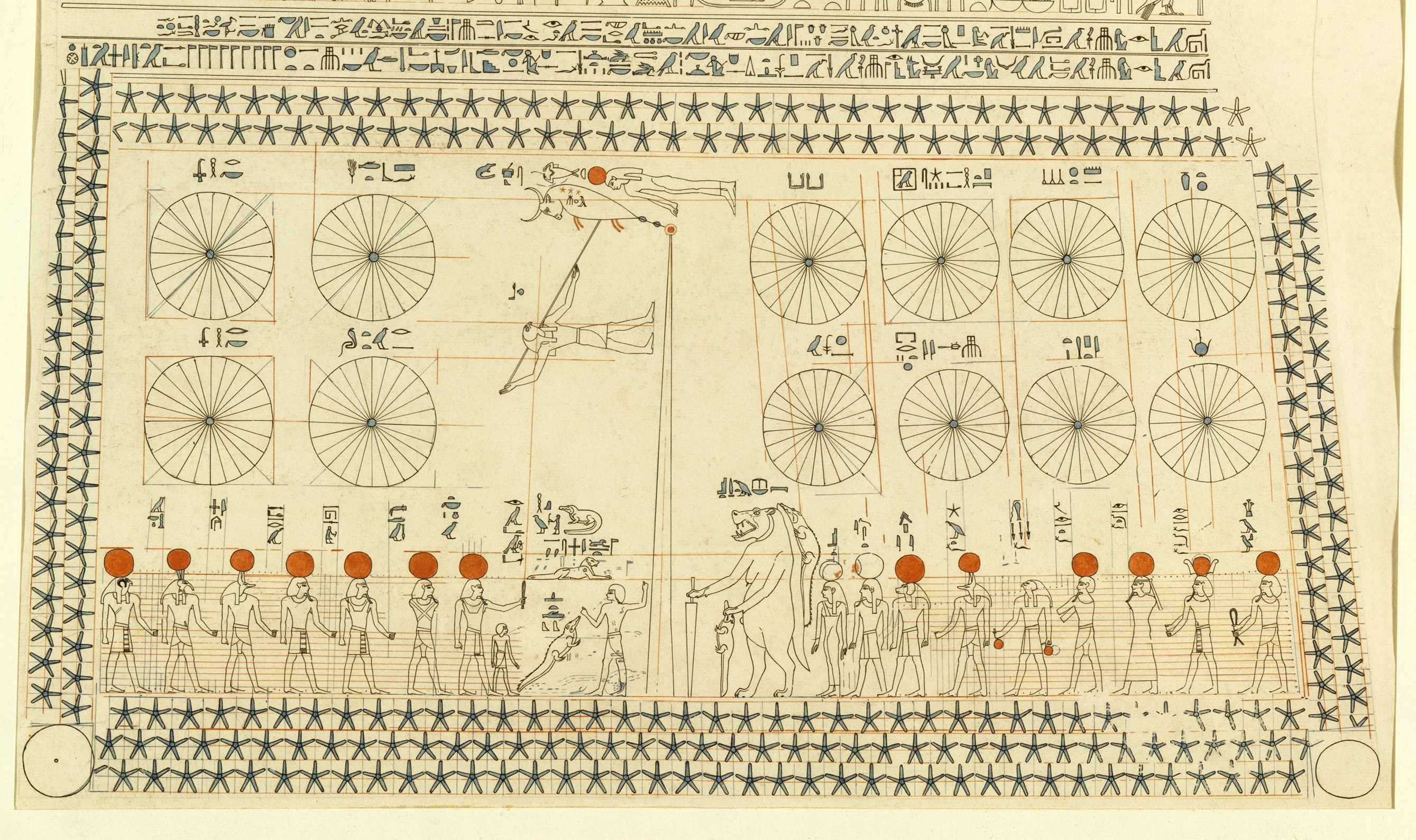
Overseer of works for Hatshepsut and the man whose unfinished tomb at Deir el-Bahari (TT353) carries the earliest surviving Egyptian astronomical ceiling. Its northern panel sets out the circumpolar constellations and the Bull's Foreleg; its southern panel lays out the decanal belt whose heliacal risings divided the night into hours.
Egyptian Archaeoastronomy
The Decan Catalogue
The 36 decans are groups of stars used by ancient Egyptians to divide the sky into 10-degree segments, each rising heliacally every ten days. Together they mark the 360-day Egyptian civil year (plus five epagomenal days). Used as a sidereal star clock from at least the 9th Dynasty (c.2100 BCE), each decan governed one hour of the night sky and carried a corresponding deity.
Scholarly caveat (Sarah Symons, AEA McMaster): "Although we know the names of the decans, and in some cases can translate the names, the locations of the decanal stars and their relationships to modern star names are not known." Stellar identifications below are marked CONFIRMED (broad consensus), PROBABLE (strong argument, contested), or UNCERTAIN (proposed only). Source: AEA Database · Neugebauer & Parker, Egyptian Astronomical Texts I–III (1960–1969).
Decan Families (T-list order)
Decan Calendar — click any segment
36 decans × 10 days = 360-day civil year · hover to identify
Sources: Ancient Egyptian Astronomy Database (AEA), Department of Physics & Astronomy, McMaster University (Sarah Symons et al.), aea.physics.mcmaster.ca. · Neugebauer, O. & Parker, R.A. (1960–1969). Egyptian Astronomical Texts I–III. Brown University Press. · Leitz, C. (1995). Altägyptische Sternuhren. Leuven. · Symons, S. (2002, 2007, 2013). Classification and analysis of the ancient Egyptian astronomical corpus. · Decan order follows the T-family canonical list. Epagomenal days (days 361–365) governed by additional deities not listed here.